I want to say that it has been a pleasure bringing you my experiences from Istanbul. I enjoyed hearing your responses and your thoughts about the world equally. It is my hope that you were able to take away some worthwhile information as well!.
I wish that I could arrange to have a meet with your class once the semester is finished, but I will be staying here for another 6 months as well. So hopefully we can arrange something via Skype before the term ends!
Alot of the topics that we discussed were pretty weighty (another reason I was so impressed by your feedback!) and may be difficulty to grasp onto. So for our final blog, I decided to have a chat with someone that is in your guys’ age group, and get a little comparison on what it’s like being a teenager in Turkey.
My roommate’s younger brother Kıvanç (kuuvanc-ch) was very eager to help me out with this project. I’ve gotten to know their family a bit during my stay here, and Kıvanç has always been curious about life in America, so it wasnt so much a surprise he volunteered!
What’s your name?
Kıvanç
How old are you?
14
How is school? What are your favorite classes?
I really like mathmatics, I’ve always been good at it.
Anything you don’t like?
Sure, I hate literature
Do you speak any other languages? (Asked him this in english- laughing)
Yeaa, a little bit of english! And even less german.
What kind of hobbies do you have?
i play the guitar, I want to get even better at this. I like playing basketball and drawing also.
If you had to pick to be a rockstar or a pro basketball player which would it be?
I don’t think I could be the rockstar, but I think it would be more fun to be a player.
You’re tall enough to be a basketball player at least! (he’s like 6.1″)
Yea, sometimes that intimidates people, maybe that’s my secret weapon on the court!
So what’s your favorite music or bands?
duman (a turkish rock band), Model (another Turkish alt rock band), Kesha, Pitbull, J-lo
Favorite Movies
The Expendables, Tron, Hunger Games of course! (he had just come back from seeing the newest movie), Avengers, and Thor
If Istanbul were under attack from mutant cat aliens, who would be the better superhero to battle them? Captain America? or…?
I think Grumpy Cat would be the best.. he would just scare them away.
What’s your favorite food?
Meatballs, macaroni, kebap, kalamar (calamari)
Have you traveled a lot? Where are some places you’ve been?
I’ve been to Germany, Czech republic, Slovakia, and Austria….
Anywhere still you want to visit?
england and france and definitely the USA
Is there any big differences that you see in Turkish and American culture? What comes to mind?
Turkish people are more friendly and more helpful than Americans. Turkish kitchen food is more delicious than american food just from what I’ve tasted. I think american people more obedient and more hardworking. Turkish people have a big ottoman empire history. American people are more modern than Turkish people, Turkish people are generally lazy and generally Muslim. So they are different culture. Turkish people have more traditions and generally like taking the easy way out of a problem.
(the last point he made interested me, so asked a bit more)
So you think that Turks generally try and do a job quicker?
Yes, I think they try and do something as quick, don’t take the time to make sure it is done properly. Sometimes in school too.
Do you do this?
*laughs* Sometimes
What would you like to study one day?
I really like math so maybe I will work in science, but I also like photography so maybe I will do this also.
My roommate and Kıvanç in the background
So, again, I hope you guys have had a worthwhile time on this project. When I return in the spring to Portland, maybe we’ll have a chance to meet in the classroom. In the meantime, I encourage you guys to keep up your travels, interest in the world, and meeting new people. You never know where it will lead you!
Well guys, we are beginning to wind down our project here. Next week I will be presenting my last blog to you. For this occassion, I will be interviewing a middle school student here in Turkey, to get an idea about some of the similarities and differences that might exist between your lives and the live of a turkish teenager. Hopefully you will enjoy this!
I was impressed with your responses to last week’s blog. Also some of the words that you came up with!
This past weekend I took a little tour outside of Istanbul to a city called Bolu with some friends. Bolu is located halfway between Istanbul and the capital city Ankara in the mountains. Most of the interior of the country is sits on a high plateau with mountains criss-crossing everywhere. And while Turkey is a fairly large country, because of it’s terrain, this makes traveling quite long! Even though it is only about 150 miles from Istanbul, it took us about 5 hours to get there by bus!
The first thing I noticed in this area was that it was strikingly similar to the Pacific Northwest. There were many little villages in valleys, green forested mountains everywhere, and of course, rain and fog over everything! We spent our first day wandering around the city center, visiting the main mosque (cami – pronounced jaa-mi), small shops and vendors. Because of the terrain and climate, mushrooms and hazelnuts grow here in abundance. I learned that it is quite a local industry that people go off into the forest to harvest mushrooms, using dogs to sniff them out sometimes.
City center from mosqueCenter Square of Bolu
We also were able to find an old hamam that had been converted into a cute cafe.
Mushroom vendor in Bolu
A hamam is a typical turkish bath, sort of like a spa where a person can go to use a steam room, sauna, and get a massage also. In many larger towns and cities, it is common to find these. Especially in winter, it was a normal tradition to visit one for good health and to help with circulation issues, but anytime you go, it’s a relaxing experience.
A typical turkish hamam
After our trip to Bolu, we went further up into mountains to the village of Mudurnu, a spa town. Life seemed to move a lot slower in this village. During the day, people would sit in cafes on the one main road, but as it got closer to evening and got colder, everyone went into the pubs and resteraunts to chat and watch football matches. It was very common to see horses being ridden alongside SUV’s through the town.
Mudurnu
Early morning Mudurnu
Lake Abant
After a day here we continued to a Nature Reserve higher yet in the mountains called Abant. There is a large lake here that is the result of melting snow over the ages. Like in the other places, there are spas and natural springs here and is a popular resort, even in the winter. We made a small trek around the lake, took a carriage ride back (quite freezing by this point!), and enjoyed a piping hot cup of Salep when we returned. Salep is a traditional winter drink in Turkey, and it is made from creamed cauliflower, sweetened with sugar and various spices such as cinnamon, nutmeg, and cloves. (Kinda sounds gross, but actually its really delicious, kinda like a spicy eggnog!)
Salep
Well that’s going to be all for now. I hope you all enjoyed the week’s post and look forward to bringing you our final post next week. Just one question for you guys this week: Winter activity, what do you enjoy doing? Is there anywhere that you go away to, or just a fun tradition?
I didn’t have any cats unfortunately to leave you guys with this week, so please accept this humble stuffed falcon as a replacement 😉
I was quite impressed with the array of responses I got from the last post. Most of you seemed to take a good albeit varying stance and understanding with Turkey’s relationship with the EU. I enjoyed hearing about your thoughts on comparable situations or experiences witnessing selective interactions. Well done!
There is a lot more intricacies at play in the example of Turkey, but gauging from some of the responses some of you gave about places like the Ukraine, Mexico, and elsewhere, I think you guys get the idea of how people can feel more socially and politically inclined towards one way or another!
At the beginning of this project, I had a few students talk about whether the name of Turkey was at all related to the bird. (I get this question from other english-speaking people quite a bit actually!) I think there isn’t a better time to take a look at the etymology of Turkey (where I am) and turkey (that delicious bird that will be eaten by millions this week).
Which came first… the turkey…or, Turkey?
Here you can see where Turkic languages are spoken today. The area of green in the center is the ancestral homeland of the Turks.
Turkey gets its name from the tribe of Turks that settled here in Anatolia about a 1,000 years. Anatolia was mostly settled by Greek, Armenian, and other Christian groups at this time. The Turks arrived from central Asia (around what is now Uzbekistan and Mongolia). They were a nomadic tribe, calling themselves Göktürks (in Old Turkish, Gök meaning – sky or heaven indicated their affinity to Tengri – the shamanistic Sky God. The word Türk original meant – the strong ones). In time they settled, converted to Islam, and become one of the majority ethnicities of Anatolia.
SOOOO.. the bird.. coincidence?
Well, not quite…!
It turns out that the delicious, savory bird that we know so well for Thanksgiving is originally from North America. Spanish merchants began to ship them back to Europe following the Conquistador period, where they were then domesticated for eating. However, the Spanish sailed back often to the Mediterranean first, and Constantinople (Istanbul) was a thriving hub for sea commerce at this time. The birds stopped here first before going to places like England where they were extremely popular. Merchants there associated them with the Turks, first calling them “Turkey birds” and the name stuck!
To make it even more interesting, in India, there is a domesticated bird very similar to the turkey called guinea fowl.
This bird was traded with Ottoman merchants hundreds of years ago. The Turks began to call this bird – Hindi (since it came from India) and this is nowadays the modern Turkish word for turkey!
Confusing? You bet! But a very fun linguistical fact! It goes to show that ideas goes through some changes in meaning and concept when it jumps from one language to another.
As for my Thanksgiving plans, since this is really just an American holiday, I will not be able to do the traditional style. But so many people I know are curious about (both Turks and other international students at my university), I and a few American friends will be trying to recreate some of the dishes for them…alas, sweet potatoes are not really a thing here!
Some questions for this week:
1. Do you celebrate Thanksgiving? If so, what is a usual tradition for you/your family? If not, what is a comparable holiday you celebrate?
2. Think of a word that comes from another language other than english? How is it used? What is it’s orgin and how did it get to our language? (May require a little bit of investigation!)
3. And finally… CAT PHOTO
Because winter is slowly arriving here, like Portland, we’ve been having a lot of rain! These guys are seeking shelter where they can on the university!
I was pleased to see so many of enjoyed the music scenes of Istanbul and Turkey, and also about your own musical tastes. Many of you expressed your interests in music from places varying from China to India, to Europe. I would strongly encourage you to look into what kinds of music are happening in these places, both traditionally and modern (sometimes they uniquely get blended!) A good place to start is of course the good ol Internet (I sent some recommendations out about last.fm) but there is no shortage here. If you are wanting something a little more closer and personal, a good place to look is at cultural events and universities in the Portland area. Often there are free (or inexpensive) events that are hosted to help bring cultural awareness to residents.
One thing I do have to mention as well. I have been a little occupied with my school midterms over the past week, so unfortunately I haven’t been able to personally respond to everybody’s comments from the blog. But rest assured I did get to read them all!
This week I chose to talk about a topic that may seem somewhat political at first, but has much deeper implications in Turkey. Istanbul is well known as being the only city in the world that rests on two continents, and shows in daily life… people will often say “I have business to do on the European side..” or “I’m going to visit my family on the Asian side..” But many people ask: Is Turkey more European or Asian in general?
We’ve touched on the history of the country several times over the course of this blog, and you’ve all seen that Turkey has been ruled by various civilizations over the centuries. This gives Turkey a unique blend of feeling “west” and “east” often at the same time. While adhering to Islam for centuries, the country was pushed quite suddenly towards the West with the reforms of Ataturk. But even today, many Turks feel a sort of “identity crisis” in how to label themselves. This is one reason why I choose this week to talk about Turkey and the European Union.
In Short: The EU
The EU is a group of countries that have formed a union based on a common market (for example, most members have the same currency, the Euro), common political and cultural views, and common law. It started half a century ago, and has slowly evolved into its current form. When a new member state wishes to join the EU, they have to go through a series of tests and checks to make sure that their economy, politics, and societies are in-line with the common EU values. Just last year, Croatia was the newest member to join, before that many of the former Soviet countries in Eastern Europe had joined. These countries viewed as a step towards more stability, more prestige, and having a better livelihood for its citizens. Turkey however, has been applying for membership for over 20 years and is still a candidate in waiting. (as you can see from the yellow shading in the map above)
This has caused some bad feelings on both sides. While many leaders of the EU have vocally supported Turkey trying to join and Turkish leaders attempting to join, the people of both sides have often felt different. In Europe, there are some who worry that Turkey would be “a burden” for the rest of the Union. If a country joins the EU, people and workers are allowed to travel across borders very very easily and European worry that many Turks will come to their countries and take jobs and use government assistance. Some also worry that Christianity is a common European value and the addition of a Muslim country, with sometimes different ideals will change this
.
The Turks initially were very excited about joining the EU. They felt that they were just as European as the other countries, and that they wished to be a part of this Union. But the EU has frequently cited that Turkey denies basic human rights to some of its citizens, that is hostile towards some of its neighbors, and does not allow for more freedom of speech (Turkey has the highest amount of journalists in jail because of the stories they write). All of these requirements the EU says are fundamental values that a new country must have to join.
But after waiting for nearly 20 years and with the Turkish economy actually doing better than some European countries, Turks are starting to rethink if they actually want to be in the EU
.
If you take a look at this graph from a few years ago, support IN Turkey has gone south over the years, with more people thinking that they can survive as a country on their own.
So why the change in opinion for both??
Well, Turks have been involved in Europe for years. After the second World War, when Germany and Europe were in ruins, the German government began a program to bring Turkish migrants to the country to help rebuild Germany. During the 50’s till the 70’s, tens of THOUSANDS of Turks especially lived in Germany. Everybody thought that once the work was done, they would all return home. But many of them stayed, because living in Germany turns out to have been much better. They got payed better wages, they had better services, they started families and lived their lives. After English, Turkish is the next most spoken language in the country. But for a long time, the Turks were treated like second class citizens. They were reluctant to learn German and incorporate into German society and the Germans viewed them as a nuisance. This has thankfully started to change and the two societies are living amongst themselves better. When I was in Berlin a few years ago, I would walk through little neighborhoods where everything was spoken in Turkish, I didn’t hear any German! I could have been in Turkey for all I knew!
German Chancellor Angela Merkel eating a Döner Kebab. Turkish food is probably the biggest cultural export in Germany, almost everybody eats or knows the food!
So because there are already so many Muslims living in Europe, this is part of the argument anti-Turkey-into-the-EU people make; what if more come? what if they don’t work? or what if so many come that they can change our laws?
When I was sitting with my roommates talking about this issue, they asked me “Isn’t it the same way with immigrants coming from Latin America to the US?” After I thought about it a bit, I think they are definitely some similarities between the two issues. You have groups of people that are coming here to America hoping for a better life, but they face lots of challenges and are not always welcomed with open arms.
Another friend of mine here made a different analogy: “It’s like when you are children and you make a fort. You say to your friends ‘If you are this tall, you like this food, and this music, you can join..’ but then when some kid you don’t know comes and says like all these things and they wants to join, you tell him no”
There are lots of factors that play in this process, probably why it doesn’t look to have a solution anytime soon. Cultural, religious, political parts play in the picture. For the time being, Turkey will remain a neighbor of Europe.
Some questions for you all now:
1. What were your thoughts on this blog?
2. Thinking about the tense relationship between EU and Turkey, what are some similarities that you can see elsewhere in the world. What I mean, people wishing to join another group/country often have various struggles, what are some of these?
3. Thinking about the analogy of the fort, was there a time when you witnessed somebody being “selective” like this?
Hope you had a cool Halloween and a good week. Halloween isn’t too much of a big deal here, even finding a pumpkin was exceedingly difficult, so hopefully you had some fun for me!
About last week’s post, I was pleased to see how many of you grappled onto the idea of gender differences. It’s often a difficult subject because so many factors help play into the picture (culture, tradition, rights) and also was interesting to hear about how and why you express yourselves.
For this week, I got my idea of a topic by walking down Istiklal Avenue (the really big main street in the center, remember?) It’s really something like Broadway in NYC, you can find every kind of person from all over Turkey and the world. It is infamously known as a place where buskers (street musicians) are playing all kinds of music, mostly traditional folk music from different parts of Turkey, but also classical and international (there is a Peruvian flute group always there!) But this is important as not only is the street always filled with tourists who help to support the artists, but Turks take pride in having this open area for musicians, painters, and other artisans to show off their craft. I thought it would be a good idea to talk a little bit about music in Turkey, the different varieties, and about some of the people behind it.
Here’s a few clips from some street musicians I made:
In the last video, the young man is holding what’s called a Black Sea “Kemence”, an instrament that looks like a fiddle, but it is held vertically while played. .
Along with the “Tulum” –a turkish bagpipe– these instraments are very common in traditional music of the Black Sea region. This region was historically home to many Greek, Georgians, and Armenian peoples. Though they are not as noticeable in society, their impact was left in their music.
Another traditional instrument is the bağlama (Baa-lama), this is perhaps on the more common instruments, and can often be heard walking down a place like Istiklal Street. This guitar-looking instruments is found all over the country, and was traditionally what the traveling musician or bards would play.
In the eastern part of the country, the bağlama is used in a lot of Arab and Kurdish styles of music. The Kurds are a separate ethnic group in Turkey, with their own language, culture, and history. The have often been the minority of the country and this has led to conflicts at times over the years. You can see a typical song and dance for Kurds here.
However, probably the most popular form of music is easily pop: while American and western pop music is well known and played, Turkish pop is a genre of its own. It is even exported to the Balkans in Europe and other places of the Middle East. The most well known singer is easily Tarkan.
This guy plays sold out shows and venues all over the country and is a good example of Turkish pop. Girls go crazy when they hear him play, guys pretend not to be interested, but you know they will dance to it. Here’s a clip of his more popular videos “The Love is Gone”
I recently had a chance to go to a club where a well known female artist was playing. Her name is Ceylan Ertem, she typically plays in small venues and cafes but is quite popular in Istanbul. My friend that I was with told me “She dresses like Miley Cyrus, but trust me, she isn’t!” I found out that she typically takes older folk and “turkish oldies” and performs more modern covers for them. While this isn’t the show I went to, it’s a much better recording than what I made, her song “I Left my Heart in Aegean” here.
So now that you’ve gotten a brief look at Turkish music, some questions to think about:
1. What were your thoughts on the post?
2. What music do you enjoy listening to?
3. Is there music from a particular place in the world that you are curious about?
Regarding these photos: This last Wednesday was the “Republic Day” holiday (Happy 91st Birthday Turkey!) commemorating the founding of the Turkish Republic. It is a day where one will see flags and pictures of Mustafa Kemal EVERYWHERE. In the first photo,there was to be a firework show near the Bosporus Bridge, but there had been a large accident at a coal mine in the country the day before, so in solidarity, the fireworks were cancelled.
Response to Last Weeks Replies
I was glad to see many of you were able to connect some of your own favorite foods and customs to what was discussed here! Many of you noticed that some of the traditions are very similar between countries. Even something as seemingly insignificant as a superstition can help tell a story about one’s culture, you don’t even necessarily have to believe in it!
This Week’s Topic
One question I frequently get is because of Turkey’s mix of “east-west” culture is how women are treated and perceived in present themselves in society. In general, there is no easy answer to this, but I will try and shed some light on this issue.
Because of Turkey’s Islamic belief system, there is traditionally a huge emphasis put on women to appear with honor and modesty, especially in public. During the Ottoman period, regulations were spelled out on how women should dress, conduct themselves in life, and for married women especially this had special implications. Women traditionally wore some kind of head covering. There are many different kinds of coverings that exist even today in societies, An illustration here may help to distinguish them here.
It is noteworthy to point out that muslim cultures are not to only ones that have a practice of wearing head coverings: In Russia and other Slavic countries, among Christian-Arab cultures, and others, women have traditionally worn these. Sometimes it may have religious backgrounds, but it was also practical for rural workers on farms (to keep out the sun and dust for example).
When the Mustafa Kemal created the Turkish Republic, he wanted to make his new country more “European”, and thus discouraged women from wearing most forms of head scarves, and afterwards became illegal for women in the public sector to wear them at work (government employees, lawyers, judges, teachers, and other bureaucrats) as well as students. It was believed that religious signs of expression should be a personal matter.
However, in the 1980’s there began to be a more popular movement to allow these expressions in certain parts of life. More and more students challenged this rule by wearing scarves to state-owned universities. Over time, it began to become a more acceptable sight for most women.
Last year, 4 women elected to the Turkish Parliament were allowed to wear headscarves in the chambers
Today, according to a recent survey, a majority of women in the country wear some kind head covering. But interestingly enough, a majority also agree that it is up for the woman herself to choose what she wishes to wear.
At the heart of the controversy here is the fact that the current Turkish Constitution puts a great emphasis on a separation and distance on religious expression. Those who follow the practices of Ataturk believe that if religion is not controlled, it will slowly lead to more radical ideas that could destabilize the country. There is also the fear among them that the current government is pro-islamic and is asking for more rights for just Sunni Muslims but not others. Those wishing for more freedom of religious expression say it is unfair for the state to tell them what they can and can’t wear. It’s an interesting topic and is currently very hot in Turkey!
A good friend of mine at my university, Renan, who also chooses to wear the scarf (and I would say is pretty liberal) gave me an interesting bit to think about “You can only tell so much about a person from first appearance; some girls where clothes from H&M with “Juicy” written on it, some cover their heads. Until you get to know them personally, you can’t really know what kind of person they are”
Education
Since the founding of the Republic, there has been a large emphasis to bring more people into public education, especially women. Turkey has a very large percentage of children who attend public elementary school, and because of this, a high literacy rate. Women are encouraged to attend school and universities if possible. At my university, I was fascinated to find out that more than 65% of the students were women! Because they have a high degree of university placement, women are being found more and more in higher paid positions in the workforce. However, like in the United States, these is still a discrepancy between women in men in some of the higher levels of work, both in terms of position and pay.
One last photo I will leave you with: Last year there was a major political demonstration in Istanbul. In the main square, Taksim, there were plans by the government to tear down a park to build a shopping mall. This resulted in tens of thousands of people, mostly young ones, protesting against the government’s actions. Many people from different backgrounds and walks of life (including women!) came to attend these protests that ultimately became a national event. You can read more about it by googling “Gezi Park Protests”. The photo below shows a bit of this unity the country felt.
So my questions to you this week are:
1. What did you enjoy most about this week’s post?
2. Why are women’s rights an important topic to discuss?
3. What is the importance of self-expression (think about how you express YOURSELF on a daily basis, whether through clothing, style, activities etc)
Also:
Our new cat Justin inaugurated his stay…notice the guilty look!
I was glad to see so many of you enjoyed some of the more historical sights of Istanbul. I will be posting more sights as I find them so don’t worry!
But as promised this week we will be looking a bit more at some of the cuisine and customs of the country. I’m going to cover a few of the main and most noticeable ones as there is A LOT of amazing food here! Similar like the art and architecture, every group that has called Turkey home over the centuries has left its mark on the table so to speak!
But let’s start with the most important meal of the day: Breakfast. So we know that Portland is pretty well known for how it handles its B-fast, so I was especially curious to see how this would be in Istanbul; let’s just say it was not disappointing at all! Instead of having one or two main things to eat, typical Turkish breakfast is a meal of options and spreads; there is all kinds of jams, honey, cheeses, and sweets to choose from. I posted an interactive picture so you can scroll over some of the foods for descriptions here
But something that you will see all the time, all over the country is undoubtedly — çay – tea
Typically served in a glass tulip-shaped glass like this
Tea is served at almost all times of the day, but you will almost always see it being served with breakfast especially. It is a black loose leaf (similar to earl grey) that turns red when it is brewed and served with sugar usually. People will have a glass throughout the day, on their breaks, at work, or when guests come to visit.
Men enjoying çay and tavla (backgammon) a popular leisure gameEveryone enjoys a good tea 😉
Another popular food, especially on the streets, is kebab. These are really similar to Greek “Gyros” (in fact we have 2 turkish kebab foodcarts in Portland). Traditionally it is lamb or beef chunks that are put on giant spits, roasted, and then very thinly shaved off into sandwiches.
Last week I was invited to my friend Ali’s house. He was going to make us food typical for his area of Turkey, Antakya, very close to the Syrian border in Mesopotamia. Typically in this area, most of the cuisine is very spicy, which is great for me because I am a fiend for hot food! Here’s another interactive photo of this dinner here.
Customs and Superstitions
My first impressions of Turkey was how friendly the people were. It is very common for people in your neighborhood to greet you and I have been invited to tea several times. Most people are excited that foreigners are curious about their country and if you know a word or two of Turkish they are delighted that you are making an effort to speak their language.
In greetings, Turks are much more informal than Americans. A typical first greeting is to shake hands, but after your initially introduction, it is common to greet people with a kiss on both cheeks or even a hug, for both men and women, depending on how comfortably you know them. Men are much more touchy with each other, it is very natural to see man walking with their arms locked or even holding hands. This isn’t a sign of sexuality but rather how close of friends they may be.
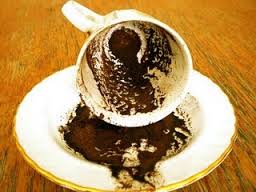
Another interesting custom happens sometimes when you are drinking a cup of turkish coffee. As explained above, this coffee has the coffee grounds at the bottom of the cup, looking a little like sludge. But when someone has finished a cup, many times friends will “read the grounds”, similar to reading tarot cards. They will look for images and symbols to predict the persons future. This practice of reading ones future is called fal.. it can range from actual businesses predicting future to joking fun between friends. Reading palms is also apart of this.
To read your fal, after drinking your coffee, it is turned upside down and left to cool for a momentwhen it is turned off, somebody will look for symbols left in the coffeegrounds
Typically, Turks have many interesting customs that make them very distinct from other peoples. Traditionally, many of these are superstitious in nature. I was interested to find out many superstitions are shared between our culture: walking under a ladder is EXTREMELY unlucky, breaking a mirror, almost anything doing with a black cat, in fact there is a common phrase in turkish regarding this:
Aramızda bir kara kedi var – literally between us a black cat there is , meaning “there is some bad feelings between us, all isn’t well with us”
Similar to many other cultures in the world, some Turks believe in the notion of an “evil eye” (nazar). The concept is basically if someone is jealous of you or the things that you own, they may inadvertently put a “hex” or bad jinx on you, basically cursing you. Turks have an amulet that is supposed to protect them from the evil eye someone may put on them. It is a blue amulet with an eye on it… you can see people hanging this in their car, on jewelery, in their homes, etc. While often it is more a cultural expression than actual belief (think of some of the religious icons you see in daily life), it is seen everywhere here.
When a compliment is give to somebody (new baby is born, someone gets marriend) (How beautiful your baby is, may you be happy! etc) superstitious people will often add the phrase “Maşallah” (praise be!) afterwards because according to tradition otherwise you might accidentally put a jinx on them! These traditions are becoming less noticeable, usually among st the older population but you will still hear people giving greetings like this just out of habit.
So in looking at some of the things we discussed here, I’m curious to hear about your thoughts. For this week’s assignment:
1. What did you enjoy most about this post?
2. What is your favorite food and where (if you know) does it come from?
3. What’s a tradition/custom/superstition that you know of and what makes it unique?
First off, I was really impressed by the wide range of responses from last weeks post. It was interested to hear about your own holiday preferences/memories/traditions, and what you thought of Kurbabyn Bayramı. I was also very astounded by some of your takes on the policies of Mustafa Kemal Atatürk. Even though many of them ranged in opinion, you all managed to hit on topics that are still being discussed even today in Turkey. Aferin (well done!)
For this week, I have put together a few photos/videos from my so-far adventures around Istanbul, seeing a few tourist destinations and historical sites and thought I’d share them with you. Also can take a look at how the city has changed over the recent history to become a modern metropolis.
I put together a map so that you can see some of the places that will be discussed here and have an idea where things are located here.
Istanbul has been around as a city since the times of ancient Greece, when it was known as Byzantium. However, the city grew to prominence when the Roman Emperor Constantine the Great moved the capital from Rome to here, renaming it Constantinople after himself, with the hope of creating a new Christian center of the Empire.
Over the next few centuries, enormous cathedrals and other public works were built that survives to this day.
Hagia Sophia
Built in the 500’s AD by command of Emperor Justinian, the Haga Sophia is probably one of the most iconic sights in Istanbul. It has served as a Greek orthodox basilica, later a catholic cathedral, and when Istanbul was captured by the Ottomans, it became the Imperial mosque of the city. When the Republic was founded in the 1920’s, it was reopened as a museum for all to see.
The first thing you notice about the Hagia Sophia is IT’S HUGE! Even though most of the structure has stayed intact since it was first a christian church, you can see how each group left it’s signiture through art inside.
The ceilings and walls are covered in ancient mosiacs, tile plaster paintings of various christian icons.
However, in many Islamic traditions, there is less emphasis on paintings, statues, and personable reflections of religious figures. Instead, there is a larger presence of geometric figures, architecture, and calligraphy.
Valens Aquaduct and the Cistern
This ancient roman aqueduct was built around the same time to transport water from the mountainous forests outside of Istanbul to the imperial palace, it was stored in the Istanbul cistern (an ancient water filtration and storage facility). Now it is apart of Istanbul traffic!
The Cistern is known as Yerebatan Sarayı (The sunken palace) because of it’s huge size and ornate architecture.
TopkapıPakace
One of the grandest buildings still standing is probably Topkapı. This was the main palace of the Ottoman sultans over the centuries. The palace sits overlooking the Bosporus, at the mouth of Istanbul. It is an elaborate collection of buildings, gardens, libraries, steam baths (hamam), and mosques..and almost a city itself. In addition to the imperial family living here, the palace was also home to many of the royal scribes, the aides of the sultan, their servants, and the women slaves of the sultan.
So now that we’ve seen some of the historical sights around Istanbul, it would be equally important to look at how they stand next to the newer additions.
Ever since becoming a democratic republic a little over 90 years ago, Istanbul has slowly moved towards modernization. But it is within the last 20 years that this has really picked up speed and becoming noticeable. In 2002, the ruling government party came to power, promising to open up and liberalize Turkey’s economy. This has brought lots of foreign investors and wealth into the economy. It’s clearly evident from looking at certain parts of the city!
The “new” downtown located in the neighborhood of Şişli (pronounced shish-lee)Hagia Sophia on the right, the Blue Mosque on the left, the new financial district behind them
It’s an interesting sight to see something so familiar like fast food that you take for granted, standing along side someone selling food from horse-drawn carts.
You can find anything to eat…. anythingAnd anything can be delivered to your doorOriginal “food cart”
But even though Istanbul has become a global city and a magnet for many business, it’s impossible to ignore that this is not the case for everyone living here. In certain areas, poor city planning and a rapid influx of people from rural areas have created widespread poverty. Many apartment buildings have not been renovated in years, public services like electricity, water, and gas are known to periodically be interrupted. Istanbul is also home to a large migrant and refugee population currently. Many of these are Syrians who escaped the conflict currently taking place in their country, but there are many ethnic and religious minorities that often are living in dire conditions in the city. So wealth for some does not always reach everyone.
Shanty neighborhood in Istanbul
Large cities like this are prone to have issues like this. Having so many people (almost 16 mıllıon!), constantly growing, and meanwhile catching up on current issues is not a easy thing. If any of you are thinking about becoming civil engineers, this where this skill is in most need! But I’m curious to get your thoughts of Istanbul: What was some of the sights you enjoyed seeing/reading about?
Next week: We’ll be talking about food and customs!
Also, instead of a photo of the week, I’ll give you guys a video. This is a view from my apartment building look at the new Levent district during the call to prayer. While in many cities in the US and other countries, we may have church bells to mark the hour. In most islamic countries, there are Ezan –call to prayer. This happens 5 times each day from each mosque, as a kind of gentle (but loud!) reminder for people to pray in accordance with islamic tradition. You can hear several different chants in this video, and they are almost like waves, rolling over each other. Enjoy!
I was pleased to see so many of your comments and questions that you had about Turkey and Istanbul. I think there will be no shortage of topics to talk about!
In order to be able to get a decent enough amount of info, I’m going to try and put maybe 2-3 topics in each post (if this doesn’t work out, we can always mess with it!)
So the most noticeable thing that is going on right now in Turkey is the Kurban Bayramı (Feast of the Sacrifice). It is a holiday across all of the Muslim World by various names (Eid-al Adha in arabic), but it is meant to commemorate Abraham’s almost-near sacrifice of his son Ishmael. During this feast, there is a lot of family gatherings, a lot of food, and for many people a chance to get away from the cities and go to the coast or somewhere warmer. But as just as many people are returning to their ancestral homes, many are coming into Istanbul! The main street in the center of the city is Istiklal Street, leading to the main square, Taksim. This street has musicians, street performers, and people from every corner of the world.
Istiklal StreetIstiklal Street is always filled with people!Istiklal empties in Taksim Square, the main center of the city.
But the center point of the celebration, is the lamb! According to the story from the Koran/Bible/Torah, instead of sacrificing his son, Abraham, God had told him to sacrifice a lamb. And this is what keeps the butchers in business these 5 days of celebrating! The traditional custom is to have your lamb divided into 3 portions: one portion is for you and your family to pig out on, one is supposed to go to your neighbors and loved ones, and the last is to be donated to the poor and hungry.
The sheep wish the turkeys a happy Christmans, the turkeys a happy bayram to the sheep
For many Muslim this holiday is a time to visit their non-Muslim neighbors and friends, invite them to dinner, and tell them a bit about the holiday. Some friends and I will take a trip tomorrow to the Black Sea town of Şile, so I will have something new outside of İstanbul to show!
Atatürk: The Founder of the Republic
I know from many of your introductory posts, you are curious about how culture and life is in Turkey today. However, it would be a impossible to describe modern Turkey without looking at it’s recent history. Before 1923, Turkey had been known as the Ottoman Empire, a large swath of land that spanned from the Balkans in Europe, through most of the modern Middle East and Northern Africa.
The Ottoman Empire at it’s height and before it’s eventual disintegration.
The capital of this empire was Constantinople, which became Istanbul. Some of you might know the song that came from this historical name-change, if not, you can listen here. From this city, the sultan ruled over his huge empire, and served as the Caliph – the symbolic head of all Muslims of the world (think kinda like the pope for Catholics).
After the end of the First World War, the Empire was left weak and bankrupt. After a lot of fighting within the territory, a soldier from the Ottoman Empire decided to make the area we now know as Turkey a modern republic. This man was Mustafa Kemal, later named Atatürk – meaning “the father of Turks”.
Atatürk – Founder of the Turkish Republic
Atatürk wanted to have a country that was modeled after the countries in Europe, and move away from the more traditional, religious based rule of law that the Ottoman Empire had upheld for centuries. Some of the major reforms he made were:
1. He abolished the sultan as head of the country and as head of Islamic faith. Instead, the new nation of Turkey would be ruled by a parliamentary democracy with citizens electing their leaders.
2. A new code of law based after the French Civil Code was established. This replaced Sharia Law, a code of laws from the Koran based on the prophet Muhammad.
3. There was a strict separation of religious and state matters. This is known aslaïcité, from the french term. It is a little different from the separation we have in America, where religion is seperate but can do more or less as it pleases within the law. With this new law basically the state laws trumped all religious laws and orders. Because of this, Muslim clerics “imams” are appointed by the state, women were not encouraged to wear the veil, and could not hold state jobs if they did (ie. police, teachers, civil jobs etc)
4. Perhaps most impressively, Atatürk decreed that the national language would be changed to modernize it. This happened in two ways. Previously in Ottoman times, the Arabic script had been officially used for writing, which made it difficult to translate into spoken Turkish (Arabic and Turkish are actually nothing alike in nature). Atatürk decided to adopt a Latin based alphabet that fit to spoken Turkish better. He also expelled many of the Arabic and Persian loanwords to have more “pure” turkish words in the language. At the time, 80% of the new citizens lived in rural areas and were not educated. These new reforms helped charge literacy rates and educating people. Below is an example of the old and new script
Ottoman caligraphyModern Alphabet
5. The last main point I’ll touch on is one of identity. From the map you can see that the old Ottoman Empire was quite large, full of all kinds of different people. When Turkey was founded, everyone was to think of themselves as “Turkish” and learn to speak and read the new turkish language. This brought the country into a kind of unity, but it has been problem-some for those who are trying to preserve their own unique identity.
The remarkable thing today is that Atatürk is still very much beloved by most of the people. You will see his portrait in ever child’s classroom, from buildings, and people talk about him very fondly. It is actually a law forbidding anyone to talk badly of him or the Turkish state in public, and the punishment for this has been severe in the past! Many authors and journalists have been imprisoned for criticizing the government for the way it may have handled a certain situation.
So my questions to you guys this week are:
1. What did you find interesting about this week’s topics?
2. What is your favorite holiday and why
3. What did you find interesting about Mustafa Kemal Atatürk? If you were in his place, would you have done something differently?
Oh and here’s the cat photo of the week!
King Trash Mouth (Black) and Mr. Kittles (orange)
These two guys “live” practically on my front door step. In the morning and evening, they are always huddled up together! We even gave them names.
So for my first post here to you, I plan on introducing myself and a little of Turkish life I’ve had in the past few weeks. Over the next 15 weeks, I will be presenting you with life in Turkey. There will be many themes of course with this, looking at daily life, culture, history, food, similarities and differences, but also I will be looking to your questions you have about Turkey. Think of me as your private investigator, as the blog is called, “on the ground in Istanbul”! At the end of this first post though, I will be wanting to get know a little about each of you and what some of your expectations are. We will also hopefully be able to have a Skype meeting in the next week to get a little bit better acquainted.
So first a little about me. My name is George Rohrich, I am a senior at Portland State University studying International Development and minoring in Turkish studies. International Development focuses on how people, communities, and even governments improve the daily lives of it’s people. This can be with infrastructure (building bridges, planning roads, schools, etc), or with health (providing access to clinics, raising awareness about disease and illness), or social issues (encouraging public participation in voting, alleviating poverty or joblessness). Many of you may have done volunteer projects through your school, places of worship, or with family or know someone who has. That’s basically what I will be doing 🙂
But why study this in Turkey? Well, there is two answers to this. Firstly, Turkey is a country that for many decades has been labeled a “underdeveloped” or “developing” country. Both of these are terms we use for regions that have potential for economic growth and success but maybe have not reached it yet. However, within the last decade, Turkey has almost literally exploded with business. More companies are sending workers here, people are climbing out of poverty, and having better access to education, health, and social standing. I am curious to see how this process is working and changing the country.
The other reason for my coming here is a little more personal. I was actually born in this country and have always wanted to come back. Both of my parents served in the military and were stationed here in the 1980’s and I spent my first few years here. So on top of my studies it was my curiosity to return to the land of my birth.
So now, let me talk a little bit about Turkey
Turkey is a large country sitting atop a high plateau called the Anatolian Peninsula (think Eastern Oregon, they look very similar in a lot of places!) However, one thing incredibly unique for Turkey is that the country is located on two continents, and Istanbul is the meeting point for those two places. Over the last few thousand years, many different peoples have ruled over the land that was Turkey, some coming from Europe, some from further south in the Middle East, and some from central Asia (what we might now call Mongolia). All these different mixtures of people have created a tapestry of culture, food, and language, making Turkey rich in history.
On this map, you can see the how the country is shaped. To the north is the Black Sea, to the south is the Mediterranean and to the east where all the islands are located is the Aegean Sea. The capital city is Ankara located in the heart of the country. Istanbul where I am living is circled in red in the upper left hand corner. A large waterway, called the Bosporus separates the city into two parts, one side being Europe, the other side Asia.
Here’s a view from Europe looking into Asia.
Another view from my university Boğazici (Bo-waa-zi-chi) – meaning “Bosporous”
Turkey has a population of about 82 million people, with about 14 million living in the Istanbul Metropolitan Area. This makes Turkey quite a populous country, and with Istanbul very densely populated. What is amazing is how much history can be found walking around the city. We will have a chance to talk about the history of the city in greater detail in posts to come!
One of the first things that really struck me when I arrived here 2 weeks ago…. the city is utterly filled with cats all over. The Turks are very fond of their cats, many families keep them as pets, but more striking is that they are allowed to roam the streets freely. Many people will even leave bowls of water and food for them outside their doors. At my university campus especially, you cannot go a few feet without seeing a cat sunning itself in the grass or a group of cats patiently waiting for someone at the cafe to drop some food. I learned that in Turkey, aside from having a great affection for animals, many are spade and neutered, and then allowed to roam as they please as an alternative to having unwanted animals put down. I found this to be an interesting solution. They help keep down pests in the streets and peoples home and are relatively harmless. Call it a little cultural difference I guess!
Curiousity…
fed the cat. (yea, starbucks is a pretty new thing)
So I’m going to leave that for the first blog. NOW, I’d like to hear a little from you guys, in your response to the blog tell me a little about the following:
-Your name
-Your favorite 2 hobbies
-If you have had a chance to visit a country outside the US, what was your favorite part? If you haven’t yet had the chance, where would you go and why?
-What issues surrounding Turkey and this project are you most curious about? And what are your thoughts to this first post?
I look forward to talking with each of you and sharing the experience!
Görüşürüz! (Gur-ush-a-ruz) Turkish for goodbye!
GEORGE ROHRICH SHARES HIS ADVENTURES WITH MS. KELLY'S 7TH GRADE SOCIAL STUDIES CLASS AT ACCESS ACADEMY.




 The ceilings and walls are covered in ancient mosiacs, tile plaster paintings of various christian icons.


